Friday, November 16, 2007
In honor of St. Margaret's
Today is the feast day of St. Margaret of Scotland whose name and spirit graced my previous parish. So, I'm posting this link in honor and thanksgiving for the church body that was St. Margaret's (the church building still stands, but the body of Christ that was St. Margaret's has been irrevocably changed) and with a prayer for the church body that remains there still. I miss so many of them.

Wednesday, November 14, 2007
*AHEM* The REAL first Thanksgiving
Please forgive my moment of snobbery, but Virginians are not a truly humble lot when it comes to our history. This is the time of year we get our hackles up..all these black-shod Pilgrims! I say...BAH HUMBUG! Allow me to do my part to dispel these sad rumors that have placed the first Thanksgiving in Plymouth.
"What?" you say...you didn't know? Well, allow me to introduce you to the history we Virginians hold dear.
The first colonial Thanksgiving was held at Berkeley Plantation in Virginia - not Plymouth, Massachusetts. This location is not far from the Jamestown settlement (1607). Here is what the "Virginia is for Lovers" tourism website says about the day:
On this day, Dec. 4, 1619, these 38 men from Berkeley Parish in England were given the instructions: "Wee ordaine that the day of our ships arrivall at the place assigned for plantacon in the land of Virginia shall be yearly and perpetually keept holy as a day of Thanksgiving to Almighty God."
Here is a great history lesson from another website (which happens to be local to the Jamestown area - Chesapeake, VA, actually). You'll see why my Anglicanism runs deep...one of my family's ancestors is mentioned, a Reverend Robert Hunt. Oddly, I'd never realized that he was among the original Jamestown colonists. Mom neglected to tell me that part!
And from the First Among Virginians: I'm sure he had Berkeley and not Plymouth in mind. :)
"What?" you say...you didn't know? Well, allow me to introduce you to the history we Virginians hold dear.
The first colonial Thanksgiving was held at Berkeley Plantation in Virginia - not Plymouth, Massachusetts. This location is not far from the Jamestown settlement (1607). Here is what the "Virginia is for Lovers" tourism website says about the day:
On this day, Dec. 4, 1619, these 38 men from Berkeley Parish in England were given the instructions: "Wee ordaine that the day of our ships arrivall at the place assigned for plantacon in the land of Virginia shall be yearly and perpetually keept holy as a day of Thanksgiving to Almighty God."
Here is a great history lesson from another website (which happens to be local to the Jamestown area - Chesapeake, VA, actually). You'll see why my Anglicanism runs deep...one of my family's ancestors is mentioned, a Reverend Robert Hunt. Oddly, I'd never realized that he was among the original Jamestown colonists. Mom neglected to tell me that part!
And from the First Among Virginians: I'm sure he had Berkeley and not Plymouth in mind. :)
Annoying homeschool questions
Ok, now this is just laugh out loud funny, but possibly only if you are homeschooling. If you are not a homeschooler and you read it (please do, you'll learn something about us), please do not get all offended. We don't mind the questions...they just get old after the 474th time. You'll understand if we need to laugh at them a bit, right?
HT: At a Hen's Pace
(Yes, I'm shamelessly re-hat-tipping. I've no finesse about it at all.)
HT: At a Hen's Pace
(Yes, I'm shamelessly re-hat-tipping. I've no finesse about it at all.)
Tuesday, November 13, 2007
Another day, another journal
Can I tell you how many, many, many journals I've had around my house?
Well, I have a lot.
Why? Well, I love the idea of journaling, but I just can't keep it up for very long. I start a journal and keep it up for a couple of weeks or even months, and then before long... my discipline wanes.
Then a few months later, I decide I need to "do that journaling" thing again. But, one must have a shiny, clean, new journal...can't use the old one. Thus I have a number of partially-filled notebooks. I find that depressing...it seems such a failed task.
A couple of months ago, I gathered all those journals (I think there were 8 or 9) and looked over them. I ripped out all the pages, put them in order, and stapled them together. What a difference that made! What had seemed a collection of fits and starts...was actually a fairly good journal covering the last 5 or 6 years. Sure there are some huge gaps, but all in all, I have a decent account of my thoughts and experiences. That was a great encouragement!
Journalling is a discipline I want to incorporate into my daily life...but, I have yet to find a method that suits me. Perhaps I am too perfectionistic. This perfectionism means I desire to have a journal that is "just so"...orderly, comprehensive, disicplined, and yet, that doesn't really reflect me. It also doesn't suit me. And when I cannot maintain that level of order and discipline, I give up!
I need to let go the desire to produce a perfect journal. I need to just JOURNAL. So, I'm going to try once again. However, this time, I'm going to control my desire for perfection. This time, I'm going to keep these words in mind...
"What sort of diary should I like mine to be? Something loose knit and yet not slovenly, so elastic that it will embrace anything, solemn, slight or beautiful that comes into my mind. I should like it to resemble some deep old desk, or capacious hold-all, in which one flings a mass of odds and ends without looking them through. I should like to come back, after a year or two, and find that the collection had sorted itself and refined itself and coalesced, as such deposits so mysteriously do, into a mould, transparent enough to reflect the light of our life, and yet steady, tranquil compounds with the aloofness of a work of art."
~Virginia Woolf, from A Writer's Diary
(As quoted in "Some Deep Old Desk or Capacious Hold-All": Form and Women's Autobiography, Suzanne Juhasz, College English, Vol. 39, No. 6. (Feb., 1978), pp. 663-669.)
(Hat tip: Holy Experience)
I have a new journal (well, really it is an old one that was a gift, but has never been used). I hope it will be a place to record any sort of "solemn, slight or beautiful thing" that I find delight in.
And I'm going to allow it to be imperfect.
Well, I have a lot.
Why? Well, I love the idea of journaling, but I just can't keep it up for very long. I start a journal and keep it up for a couple of weeks or even months, and then before long... my discipline wanes.
Then a few months later, I decide I need to "do that journaling" thing again. But, one must have a shiny, clean, new journal...can't use the old one. Thus I have a number of partially-filled notebooks. I find that depressing...it seems such a failed task.
A couple of months ago, I gathered all those journals (I think there were 8 or 9) and looked over them. I ripped out all the pages, put them in order, and stapled them together. What a difference that made! What had seemed a collection of fits and starts...was actually a fairly good journal covering the last 5 or 6 years. Sure there are some huge gaps, but all in all, I have a decent account of my thoughts and experiences. That was a great encouragement!
Journalling is a discipline I want to incorporate into my daily life...but, I have yet to find a method that suits me. Perhaps I am too perfectionistic. This perfectionism means I desire to have a journal that is "just so"...orderly, comprehensive, disicplined, and yet, that doesn't really reflect me. It also doesn't suit me. And when I cannot maintain that level of order and discipline, I give up!
I need to let go the desire to produce a perfect journal. I need to just JOURNAL. So, I'm going to try once again. However, this time, I'm going to control my desire for perfection. This time, I'm going to keep these words in mind...
"What sort of diary should I like mine to be? Something loose knit and yet not slovenly, so elastic that it will embrace anything, solemn, slight or beautiful that comes into my mind. I should like it to resemble some deep old desk, or capacious hold-all, in which one flings a mass of odds and ends without looking them through. I should like to come back, after a year or two, and find that the collection had sorted itself and refined itself and coalesced, as such deposits so mysteriously do, into a mould, transparent enough to reflect the light of our life, and yet steady, tranquil compounds with the aloofness of a work of art."
~Virginia Woolf, from A Writer's Diary
(As quoted in "Some Deep Old Desk or Capacious Hold-All": Form and Women's Autobiography, Suzanne Juhasz, College English, Vol. 39, No. 6. (Feb., 1978), pp. 663-669.)
(Hat tip: Holy Experience)
I have a new journal (well, really it is an old one that was a gift, but has never been used). I hope it will be a place to record any sort of "solemn, slight or beautiful thing" that I find delight in.
And I'm going to allow it to be imperfect.
Don't tell the *other* side of the family, but....
| Your Inner European is French! |
 Smart and sophisticated. You have the best of everything - at least, *you* think so. |
Mais, bien sur!
Monday, November 5, 2007
A Portrait of Anglican Reformation
In my last post I alluded to a new Reformation in the Anglican church. (Actually, since the Anglican church didn't come directly out of the Protestant Reformation, it might be called the Anglican Reformation.) So, what would that new reformation look like?
Well, here's a good start from The Reverend Johnathan Millard:
1. There is confusion concerning who God is:
Over the past 40 years there has been a drift away from orthodox ways of speaking about God. In some places in TEC instead of God being referred to as Father, Son and Holy Spirit, He is addressed only by function as creator, redeemer and sustainer, and not in personal ways. The problem with this approach is that it makes God more remote and the fact is God has revealed himself to us through the Scriptures not just by function, but in personal terms as Father, Son and Holy Spirit. Another example is when the name LORD is replaced with "God." So instead of the Liturgical greeting:"The Lord be with you" you may encounter in some parts of TEC "God be with you" or even "God is in you" with the response: "and also in you." The word LORD apparently is perceived as too male, and too authoritarian.
The earliest creedal statement was simply "Jesus is Lord." And yes, it was meant to be authoritarian. I was very sad when I attended the Interfaith service at Calvary last week, to see precisely such a change had been made to the liturgy. When it came to share the Peace, the wording was not: "The peace of the Lord", but rather "The Peace of God."
2. There is a lack of clear teaching about the divinity of Christ:
In answer to a question referencing the divinity of Jesus, in an article published earlier this year, the Presiding Bishop, Katharine Jefferts Shori, said this: "If you begin to explore the literary context of the first century and the couple of hundred years on either side, the way that someone told a story about a great figure was to say 'this one was born of the gods.' That is what we're saying. This carpenter from Nazareth or Bethlehem - and there are different stories about where he came from - shows us what a godly human being looks like, shows us God coming among us." At best that is ambiguous or confusing, and at worst it is false teaching.
Jesus was much more than someone who "shows us what a godly human being looks like." And the Church does not say that he was "born of the gods." The biblical witness and the faith of the church is that Jesus is the Son of God: fully God and fully man. The Word became flesh (John 1). We proclaim this truth weekly in the Nicene Creed.
3. There is a lack of clear teaching about Salvation and Sin:
Questioned about selfishness and falleness, the Presiding Bishop said this:·"The human journey is about encouraging our own selves to move up into higher consciousness, into being able to be present in a violent situation without responding with violence ... " and in the same interview she went on to say: "The question is always how can we get beyond our own narrow self-interest and see that our salvation lies in attending to the needs of other people."
This is not the Gospel story of sin and redemption. The Scriptures teach that all have sinned and fall short of the glory of God. (Rom. 3:23). The Scriptures teach that salvation is not through our works, or our efforts to move up to a higher consciousness, or even through attending to the needs of others. Our salvation lies in Jesus, "who while we were still sinners, died for us." (Rom. 5:8); and all who believe in the LORD and call upon his name will be saved. (Rom. 10:13)
4. There is a drift towards universalism:
The Presiding Bishop says of Jesus: "we who practice the Christian tradition understand him as our vehicle to the divine. But for us to assume that God could not act in other ways is, I think, to put God in an awfully small box" (Time Magazine: July 17,2006). Jesus said: I am the way the truth and the life no one comes to the Father except through me." (John 14:6).
When, some years ago, I first heard Bishop Duncan speak of us living in a time of Reformation of the Church throughout the world, I confess I wondered if that was a little grandiose. I now believe, without a doubt, that he was right. This was illustrated for me, once again, just last week. I was deeply saddened to hear Archbishop Emeritus Desmond Tutu deny the particularity of the Christian Faith, mocking the idea that Jesus could possibly be the only way to God, and declaring that all religions are worshipping the same God, just by different names.
The archbishop is a great man who has done wonderful work for reconciliation and peace. I salute him for all the good he has done, but I am sad and troubled that he would be so dismissive of the supreme work of love and salvation that our Lord Jesus Christ did for us on the cross.
5. There is a loss of confidence in the Gospel as Good News for all:
The official teaching of the Anglican Church on the issue of human sexuality is that which has been set out by the Lambeth Conference in 1998 (Resolution 1:10). But here's the key point concerning the Gospel that I want to make:[The Conference] "recognises that there are among us persons who experience themselves as having a homosexual orientation. Many of these are members of the Church and are seeking the pastoral care, moral direction of the Church, and God's transforming power for the living of their lives and the ordering of relationships." [emphasis added]. It is that confidence in the transforming power of God that the actions of TEC now challenge.
So instead of welcoming and loving all into the church so that they might experience transformation, TEC simply welcomes and affirms people just as they are - denying them the healing and hope and transforming power of God.
6. There is erroneous teaching and practice regarding human sexuality
Over the past couple of decades there has been a serious rejection of the clear teaching of the Bible and the Church on human sexuality and marriage. The clear teaching of Scripture and tradition and of the one, Holy, Catholic and Apostolic church is that sex is for marriage. The only sexually intimate relationships that are good and holy according to Scripture and tradition are those between a man and a woman, within an intended life long, faithful covenant of marriage. That means that pre-marital sex, extra-marital sex, gay sex, any sex outside of marriage is all contrary to God's will. This is the clear teaching of the Bible and of Jesus.
7. There is a seemingly 'social justice only' view of the mission of the church
I have struggled to find any clear statements from the Presiding Bishop about the basics of the faith. From her inaugural sermon through to all kinds of talks and sermons and interviews that I've seen or heard extracts from she seems to be concerned primarily with a political and social gospel. She seems to be concerned principally about the United Nations' Millennium Development Goals. There is much to be commended about these goals and much to challenge us - but they are by no means the same thing as the message of salvation for those who are perishing. (John 3: 16). If the Millennium Goals are our gospel message it falls seriously short of the message of proclaiming "Christ and him crucified." (1 Corinthians 2:1-5).
8. There is contempt for the Authority of the BibleBishop Bennison has said:
"The church wrote the Bible, and the church can rewrite the Bible." No, that is a serious error.
9. There is failure by Bishops to defend the faith
The role of a bishop in the words of the 1662 ordinal is: ''to banish and drive away from the church all erroneous and strange doctrine contrary to the Word of God." - Here in the States, the very opposite is true. Rather than drive away false teaching many of the bishops of TEC embrace it, celebrate it and declare to be good and holy that which God declares to wrong. To ordain an openly gay, non-celibate man - when the rest of the world urged TEC not to do this - is not only contrary to Scripture but is also an arrogant display of American intransigence.
10. There is a lack of respect for truth or unity
There seems to be a cavalier spirit among many in TEC that disregards the mandate for unity with the one holy, catholic and apostolic church. Claims are made by 'progressives' that they are putting truth ahead of unity. However the 'truth' they claim is that it's a matter of social justice and Christian virtue to bless same sex unions and permit practicing gay and lesbian people to hold any office within the church. This is, of course, is contrary to the truth as revealed in Holy Scripture. And the only unity they secure is among a tiny minority of the church worldwide.
I'm on board THAT Reformation train!
Well, here's a good start from The Reverend Johnathan Millard:
1. There is confusion concerning who God is:
Over the past 40 years there has been a drift away from orthodox ways of speaking about God. In some places in TEC instead of God being referred to as Father, Son and Holy Spirit, He is addressed only by function as creator, redeemer and sustainer, and not in personal ways. The problem with this approach is that it makes God more remote and the fact is God has revealed himself to us through the Scriptures not just by function, but in personal terms as Father, Son and Holy Spirit. Another example is when the name LORD is replaced with "God." So instead of the Liturgical greeting:"The Lord be with you" you may encounter in some parts of TEC "God be with you" or even "God is in you" with the response: "and also in you." The word LORD apparently is perceived as too male, and too authoritarian.
The earliest creedal statement was simply "Jesus is Lord." And yes, it was meant to be authoritarian. I was very sad when I attended the Interfaith service at Calvary last week, to see precisely such a change had been made to the liturgy. When it came to share the Peace, the wording was not: "The peace of the Lord", but rather "The Peace of God."
2. There is a lack of clear teaching about the divinity of Christ:
In answer to a question referencing the divinity of Jesus, in an article published earlier this year, the Presiding Bishop, Katharine Jefferts Shori, said this: "If you begin to explore the literary context of the first century and the couple of hundred years on either side, the way that someone told a story about a great figure was to say 'this one was born of the gods.' That is what we're saying. This carpenter from Nazareth or Bethlehem - and there are different stories about where he came from - shows us what a godly human being looks like, shows us God coming among us." At best that is ambiguous or confusing, and at worst it is false teaching.
Jesus was much more than someone who "shows us what a godly human being looks like." And the Church does not say that he was "born of the gods." The biblical witness and the faith of the church is that Jesus is the Son of God: fully God and fully man. The Word became flesh (John 1). We proclaim this truth weekly in the Nicene Creed.
3. There is a lack of clear teaching about Salvation and Sin:
Questioned about selfishness and falleness, the Presiding Bishop said this:·"The human journey is about encouraging our own selves to move up into higher consciousness, into being able to be present in a violent situation without responding with violence ... " and in the same interview she went on to say: "The question is always how can we get beyond our own narrow self-interest and see that our salvation lies in attending to the needs of other people."
This is not the Gospel story of sin and redemption. The Scriptures teach that all have sinned and fall short of the glory of God. (Rom. 3:23). The Scriptures teach that salvation is not through our works, or our efforts to move up to a higher consciousness, or even through attending to the needs of others. Our salvation lies in Jesus, "who while we were still sinners, died for us." (Rom. 5:8); and all who believe in the LORD and call upon his name will be saved. (Rom. 10:13)
4. There is a drift towards universalism:
The Presiding Bishop says of Jesus: "we who practice the Christian tradition understand him as our vehicle to the divine. But for us to assume that God could not act in other ways is, I think, to put God in an awfully small box" (Time Magazine: July 17,2006). Jesus said: I am the way the truth and the life no one comes to the Father except through me." (John 14:6).
When, some years ago, I first heard Bishop Duncan speak of us living in a time of Reformation of the Church throughout the world, I confess I wondered if that was a little grandiose. I now believe, without a doubt, that he was right. This was illustrated for me, once again, just last week. I was deeply saddened to hear Archbishop Emeritus Desmond Tutu deny the particularity of the Christian Faith, mocking the idea that Jesus could possibly be the only way to God, and declaring that all religions are worshipping the same God, just by different names.
The archbishop is a great man who has done wonderful work for reconciliation and peace. I salute him for all the good he has done, but I am sad and troubled that he would be so dismissive of the supreme work of love and salvation that our Lord Jesus Christ did for us on the cross.
5. There is a loss of confidence in the Gospel as Good News for all:
The official teaching of the Anglican Church on the issue of human sexuality is that which has been set out by the Lambeth Conference in 1998 (Resolution 1:10). But here's the key point concerning the Gospel that I want to make:[The Conference] "recognises that there are among us persons who experience themselves as having a homosexual orientation. Many of these are members of the Church and are seeking the pastoral care, moral direction of the Church, and God's transforming power for the living of their lives and the ordering of relationships." [emphasis added]. It is that confidence in the transforming power of God that the actions of TEC now challenge.
So instead of welcoming and loving all into the church so that they might experience transformation, TEC simply welcomes and affirms people just as they are - denying them the healing and hope and transforming power of God.
6. There is erroneous teaching and practice regarding human sexuality
Over the past couple of decades there has been a serious rejection of the clear teaching of the Bible and the Church on human sexuality and marriage. The clear teaching of Scripture and tradition and of the one, Holy, Catholic and Apostolic church is that sex is for marriage. The only sexually intimate relationships that are good and holy according to Scripture and tradition are those between a man and a woman, within an intended life long, faithful covenant of marriage. That means that pre-marital sex, extra-marital sex, gay sex, any sex outside of marriage is all contrary to God's will. This is the clear teaching of the Bible and of Jesus.
7. There is a seemingly 'social justice only' view of the mission of the church
I have struggled to find any clear statements from the Presiding Bishop about the basics of the faith. From her inaugural sermon through to all kinds of talks and sermons and interviews that I've seen or heard extracts from she seems to be concerned primarily with a political and social gospel. She seems to be concerned principally about the United Nations' Millennium Development Goals. There is much to be commended about these goals and much to challenge us - but they are by no means the same thing as the message of salvation for those who are perishing. (John 3: 16). If the Millennium Goals are our gospel message it falls seriously short of the message of proclaiming "Christ and him crucified." (1 Corinthians 2:1-5).
8. There is contempt for the Authority of the BibleBishop Bennison has said:
"The church wrote the Bible, and the church can rewrite the Bible." No, that is a serious error.
9. There is failure by Bishops to defend the faith
The role of a bishop in the words of the 1662 ordinal is: ''to banish and drive away from the church all erroneous and strange doctrine contrary to the Word of God." - Here in the States, the very opposite is true. Rather than drive away false teaching many of the bishops of TEC embrace it, celebrate it and declare to be good and holy that which God declares to wrong. To ordain an openly gay, non-celibate man - when the rest of the world urged TEC not to do this - is not only contrary to Scripture but is also an arrogant display of American intransigence.
10. There is a lack of respect for truth or unity
There seems to be a cavalier spirit among many in TEC that disregards the mandate for unity with the one holy, catholic and apostolic church. Claims are made by 'progressives' that they are putting truth ahead of unity. However the 'truth' they claim is that it's a matter of social justice and Christian virtue to bless same sex unions and permit practicing gay and lesbian people to hold any office within the church. This is, of course, is contrary to the truth as revealed in Holy Scripture. And the only unity they secure is among a tiny minority of the church worldwide.
I'm on board THAT Reformation train!
Wednesday, October 31, 2007
Cock-a-doodle-do!
When you get some reinforcement, you gotta "crow" a little bit. Homeschooling has just gotten more reinforcement from a study...and once again, it receives high marks! So, if you homeschool, enjoy some good news. And if you don't, give your homeschooling friends the pat on the back they probably need.
Tuesday, October 23, 2007
Rethinking the mundane
I'm in a bit of a cooking funk right now. This just happens to me sometimes - most especially when life is particularly busy, which it is. This also means grocery shopping holds very little appeal for me. Not that it has ever been the highlight of my week, but I can usually find some joy in an hour of quiet contemplation of "Nutritional Labeling", or methods of can stacking, or the delightful variety of apples. (Of course that is when I am able to go alone!)
Well, tonight is the night I HAVE to go to the store. No milk, no bread, ... the cupboard is bare.
Of course it isn't REALLY bare, just my perception of bare. This post today at "Et tu?' blog made me stop about my perceptions...and it made me rethink the mundane.
Hat Tip: PalmTree Pundit
Well, tonight is the night I HAVE to go to the store. No milk, no bread, ... the cupboard is bare.
Of course it isn't REALLY bare, just my perception of bare. This post today at "Et tu?' blog made me stop about my perceptions...and it made me rethink the mundane.
Hat Tip: PalmTree Pundit
Friday, October 19, 2007
Some Friday Fun -
Take the Quiz here!
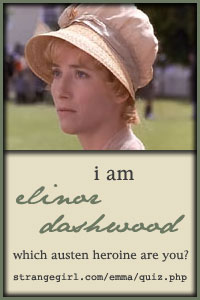
You are Elinor Dashwood of Sense & Sensibility! You are practical, circumspect, and discreet. Though you are tremendously sensible and allow your head to rule, you have a deep, emotional side that few people often see.
Because it is a rainy Friday (finally!) and I'm trying to waste time.
If you read this - consider yourself tagged and leave a comment with a link to your quiz results!
Tuesday, October 16, 2007
Aldous Huxley on holiday
***Because my son and some of his young friends occassionally read this blog, I'm putting this disclaimer here: the content of this post may be unsuitable for children. Please, if you are under 18, have your parents read this (and the links) first. Thank you!***
The new travel slogan for Norway has been announced:
"Norway, it's a Brave New World"
Didn't hear that?
Well, that is because I made it up...but it certainly would fit. Here is an excerpt from Huxley's book, Brave New World:
"That's a charming little group," he said, pointing.
In a little grassy bay between tall clumps of Mediterranean heather, two children, a little boy of about seven and a little girl who might have been a year older, were playing, very gravely and with all the focussed attention of scientists intent on a labour of discovery, a rudimentary s**ual game.
"Charming, charming!" the D.H.C. repeated sentimentally.
(...)
From a neighboring shrubbery emerged a nurse, leading by the hand a small boy, who howled as he went. An anxious-looking little girl trotted at her heels.
"What's the matter?" asked the Director.
The nurse shrugged her shoulders. "Nothing much," she answered. "It's just that this little boy seems rather reluctant to join in the ordinary e**tic play...And so I'm taking him in to see the Assistant Superintendent of Psychology. Just to see if anything's at all abnormal."
(...)
For a very long period before Our Ford, and even for some generations afterwards, erotic play between children had been regarded as abnormal (there was a roar of laughter); and not only abnormal, actually immoral (no!): and had therefore been rigorously suppressed.
A look of astonished incredulity appeared on the faces of his listeners. Poor little kids not allowed to amuse themselves? They could not believe it.
Like I said, it would fit.
hat tip: Stand Firm
The new travel slogan for Norway has been announced:
"Norway, it's a Brave New World"
Didn't hear that?
Well, that is because I made it up...but it certainly would fit. Here is an excerpt from Huxley's book, Brave New World:
"That's a charming little group," he said, pointing.
In a little grassy bay between tall clumps of Mediterranean heather, two children, a little boy of about seven and a little girl who might have been a year older, were playing, very gravely and with all the focussed attention of scientists intent on a labour of discovery, a rudimentary s**ual game.
"Charming, charming!" the D.H.C. repeated sentimentally.
(...)
From a neighboring shrubbery emerged a nurse, leading by the hand a small boy, who howled as he went. An anxious-looking little girl trotted at her heels.
"What's the matter?" asked the Director.
The nurse shrugged her shoulders. "Nothing much," she answered. "It's just that this little boy seems rather reluctant to join in the ordinary e**tic play...And so I'm taking him in to see the Assistant Superintendent of Psychology. Just to see if anything's at all abnormal."
(...)
For a very long period before Our Ford, and even for some generations afterwards, erotic play between children had been regarded as abnormal (there was a roar of laughter); and not only abnormal, actually immoral (no!): and had therefore been rigorously suppressed.
A look of astonished incredulity appeared on the faces of his listeners. Poor little kids not allowed to amuse themselves? They could not believe it.
Like I said, it would fit.
hat tip: Stand Firm
Saturday, September 22, 2007
Two , Four, Six, Eight...Who do we appreciate?
Archbishop Mouneer Anis (of Egypt and North Africa) delivered a speech at the House of Bishops Friday, September 21st that is an excellent encapsulation of what so many of us are thinking. It makes you just want to stand up and shout! Too bad the Archbishop received only "polite applause" to quote a blogger (I'm still trying to remember who...I'll update with a link when I find it!).
Be sure to go read the comments which at Stand Firm are always every bit as good as the posts.
Here is some (most) of it:
My friends, like you, we want to be relevant to the culture in which we live. More importantly, we want to be salt and light to our societies. That is not an easy calling but it means we must remain distinct and humble at the same time. Without being distinct we cannot be salt and light; without humility we will not represent the one who said, “I am meek and lowly in heart.” We are also continuously challenged whether we should allow the culture to transform the Apostolic Faith we once received, or if we should allow the Gospel of Jesus Christ to transform our culture as it has in the past. As we struggle to answer this question we must never divorce ourselves from the faith that countless men, women and children died to protect. I believer that if we faithfully serve the Church of Christ, He will continue to fulfill his promise that the gates of Hades will not prevail against her.
Rupertus Meldenius said, “In essentials, unity; in non-essentials, liberty; in all things, charity”. Our hope is to be united on the essentials of faith which are defined only by the whole church. WE are not in any way trying to impose rigid views on you. Like you we celebrate diversity, but we believe that such diversity should not be unlimited and should not contradict the essentials of our faith. We are not schismatic, but we are diligent to preserve the unity of the spirit in the bond of peace. We want unity but not unity at any expense.
Anglicans are aware with humility that we are not “the” church but we are one member of the body of Christ, the one Holy Catholic Church. We proclaim this every week in our churches. This places upon us the responsibility to listen to and respect our ecumenical partners.
My friends, you may believe you have discovered a very different truth from that of the majority in the Anglican Communion. It is not just about sexuality, but about your views of Christ, the Gospel, and the authority of the Bible. Please forgive me when I relay that some say you are a different church, others even think that you are a different religion.
I understand that it is difficult for you in your context to accept the standard teaching of the Anglican Communion. That is why you refused to accept Lambeth Conference Resolution 1.10. You also ignored all the warnings of the Primates in 2003, 2004, and 2005. Your response to the Windsor Report is seen by the Primates as not clear. You cannot say you value being a member of the Anglican Communion while you ignore the interdependence if the member churches. The interdependence is what differentiates us from other congregational churches. I would like to remind you and myself with the famous resolution number 49 of the Lambeth Conference of 1930 which declares “the Anglican Communion is a fellowship of churches that…are bound together not by a central legislative and executive authority, but by mutual loyalty sustained through the common counsel of the bishops in conference.” With respect, I have to say that those who would prefer to speak of laws and procedures, constitutions and canons, committees and process: you are missing the point! It is our mutual loyalty and fellowship, submitting to one another in the common cause of Jesus Christ that makes us of one Church one faith and one Lord.
It is clear that you actions have resulted in one the most difficult disputes in the Communion in our generation. You may see them as not core doctrinal issues. Many like me see the opposite but the thing that we all cannot ignore is that these issues are divisive and have created a lot of undesired consequences and reactions. For the first time in centuries, the fabric of our Communion is torn. Our energies have been drained and our resources are lost and it is difficult for both of us to continue like this.
My friends, if you really believe that the truth revealed to you is different from that shown to the rest of the Communion, then you need to uphold that claim with boldness even at the risk of losing unity. If you think it is right and necessary to ordain and consecrate practicing homosexuals and that you should bless same sex partnerships or even marriages, you should be true to what you believe is right and accept the consequences.
However, if you appreciate being members of the global Anglican family, then you have to walk along side the members of your family. Those who say it is important to stay together around the table, to listen to each other and to continue our dialogue over the difficult issues that are facing us are wise. We wholeheartedly agree with this, but staying around the table requires that you should not take actions that are contrary to the standard position (Lambeth 1.10) of the rest of the Communion.
Sitting around one table requires humility from all of us. One church cannot say to the rest of churches “I know the whole truth, you don’t”. Archbishop Rowan reminded us in his paper “Challenge and Hope” that “the whole truth is revealed to the whole church”. Sitting around one table requires that each one should have a clear stance before the discussion starts. It also requires that true openness and willingness to accept the mind of the whole. We do not have to be in the communion to sit around the one table. We do so when we dialogue with the Roman Catholic Church, the Orthodox and with other faiths. It would be extremely difficult to sit around one table when you have already decided the outcome if the discussion and when you ignore the many voices, warnings and appeals from around the communion.
(...)
I know that you value personal freedom and independence. The whole world learns this from you. You need to demonstrate this by securing freedom for the American orthodox Anglicans who do not share your theological direction. Show your spirit of inclusiveness when you deal with them. I am afraid to say that without this more and more interventions from other provinces is going to happen. No one wants this.
I pray for wisdom and grace, for myself as well as for you, and I pray that God will lead us both in the right direction. Remember the illustrious history of God’s church and remember future generations who will sit in judgment on us. Remember also that the whole world is waiting and watching what you do.
Please forgive me if I have said anything that offends you.
May the Lord bless you.
+Mouneer Egypt
Be sure to go read the comments which at Stand Firm are always every bit as good as the posts.
Here is some (most) of it:
My friends, like you, we want to be relevant to the culture in which we live. More importantly, we want to be salt and light to our societies. That is not an easy calling but it means we must remain distinct and humble at the same time. Without being distinct we cannot be salt and light; without humility we will not represent the one who said, “I am meek and lowly in heart.” We are also continuously challenged whether we should allow the culture to transform the Apostolic Faith we once received, or if we should allow the Gospel of Jesus Christ to transform our culture as it has in the past. As we struggle to answer this question we must never divorce ourselves from the faith that countless men, women and children died to protect. I believer that if we faithfully serve the Church of Christ, He will continue to fulfill his promise that the gates of Hades will not prevail against her.
Rupertus Meldenius said, “In essentials, unity; in non-essentials, liberty; in all things, charity”. Our hope is to be united on the essentials of faith which are defined only by the whole church. WE are not in any way trying to impose rigid views on you. Like you we celebrate diversity, but we believe that such diversity should not be unlimited and should not contradict the essentials of our faith. We are not schismatic, but we are diligent to preserve the unity of the spirit in the bond of peace. We want unity but not unity at any expense.
Anglicans are aware with humility that we are not “the” church but we are one member of the body of Christ, the one Holy Catholic Church. We proclaim this every week in our churches. This places upon us the responsibility to listen to and respect our ecumenical partners.
My friends, you may believe you have discovered a very different truth from that of the majority in the Anglican Communion. It is not just about sexuality, but about your views of Christ, the Gospel, and the authority of the Bible. Please forgive me when I relay that some say you are a different church, others even think that you are a different religion.
I understand that it is difficult for you in your context to accept the standard teaching of the Anglican Communion. That is why you refused to accept Lambeth Conference Resolution 1.10. You also ignored all the warnings of the Primates in 2003, 2004, and 2005. Your response to the Windsor Report is seen by the Primates as not clear. You cannot say you value being a member of the Anglican Communion while you ignore the interdependence if the member churches. The interdependence is what differentiates us from other congregational churches. I would like to remind you and myself with the famous resolution number 49 of the Lambeth Conference of 1930 which declares “the Anglican Communion is a fellowship of churches that…are bound together not by a central legislative and executive authority, but by mutual loyalty sustained through the common counsel of the bishops in conference.” With respect, I have to say that those who would prefer to speak of laws and procedures, constitutions and canons, committees and process: you are missing the point! It is our mutual loyalty and fellowship, submitting to one another in the common cause of Jesus Christ that makes us of one Church one faith and one Lord.
It is clear that you actions have resulted in one the most difficult disputes in the Communion in our generation. You may see them as not core doctrinal issues. Many like me see the opposite but the thing that we all cannot ignore is that these issues are divisive and have created a lot of undesired consequences and reactions. For the first time in centuries, the fabric of our Communion is torn. Our energies have been drained and our resources are lost and it is difficult for both of us to continue like this.
My friends, if you really believe that the truth revealed to you is different from that shown to the rest of the Communion, then you need to uphold that claim with boldness even at the risk of losing unity. If you think it is right and necessary to ordain and consecrate practicing homosexuals and that you should bless same sex partnerships or even marriages, you should be true to what you believe is right and accept the consequences.
However, if you appreciate being members of the global Anglican family, then you have to walk along side the members of your family. Those who say it is important to stay together around the table, to listen to each other and to continue our dialogue over the difficult issues that are facing us are wise. We wholeheartedly agree with this, but staying around the table requires that you should not take actions that are contrary to the standard position (Lambeth 1.10) of the rest of the Communion.
Sitting around one table requires humility from all of us. One church cannot say to the rest of churches “I know the whole truth, you don’t”. Archbishop Rowan reminded us in his paper “Challenge and Hope” that “the whole truth is revealed to the whole church”. Sitting around one table requires that each one should have a clear stance before the discussion starts. It also requires that true openness and willingness to accept the mind of the whole. We do not have to be in the communion to sit around the one table. We do so when we dialogue with the Roman Catholic Church, the Orthodox and with other faiths. It would be extremely difficult to sit around one table when you have already decided the outcome if the discussion and when you ignore the many voices, warnings and appeals from around the communion.
(...)
I know that you value personal freedom and independence. The whole world learns this from you. You need to demonstrate this by securing freedom for the American orthodox Anglicans who do not share your theological direction. Show your spirit of inclusiveness when you deal with them. I am afraid to say that without this more and more interventions from other provinces is going to happen. No one wants this.
I pray for wisdom and grace, for myself as well as for you, and I pray that God will lead us both in the right direction. Remember the illustrious history of God’s church and remember future generations who will sit in judgment on us. Remember also that the whole world is waiting and watching what you do.
Please forgive me if I have said anything that offends you.
May the Lord bless you.
+Mouneer Egypt
Friday, September 21, 2007
So if we aren't big "C" catholic, what do we mean?
By big "C" catholic, I mean Roman Catholic. A capital letter doesn't necessarily make "catholic" mean Roman Catholic, but that is how I often clarify it for myself.
The Confessing Reader (also under Bishop Curry) has posted on Bishop Curry's comments to the Archbishop of Canterbury while at the House of Bishops meeting. It is being reported (but, to my knowledge, still unsubstantiated) that Curry disagreed with ABC about the meaning of catholicity. The Confessing Reader has followed this up with a commentary on what is meant when we say "catholic".
The Confessing Reader (also under Bishop Curry) has posted on Bishop Curry's comments to the Archbishop of Canterbury while at the House of Bishops meeting. It is being reported (but, to my knowledge, still unsubstantiated) that Curry disagreed with ABC about the meaning of catholicity. The Confessing Reader has followed this up with a commentary on what is meant when we say "catholic".
Thursday, September 20, 2007
My Bishop speaks clearly
Yeesh - well, we here at St. Margaret's have known where our bishop (Michael Curry of North Carolina) stood on the current crisis in ECUSA, we just hadn't seen his ungloved attitude. Seems he's shown it fairly clearly.
There is more information in the comments. Be warned, not all commentors are showing their christian charity or restraint. I hope it is just the stress of the week.
There is more information in the comments. Be warned, not all commentors are showing their christian charity or restraint. I hope it is just the stress of the week.
Wednesday, September 19, 2007
Sinon, a devious gift-giver
A post for my ClassEd friends, who I know will particularly appreciate an essay that starts with a bit of classical history! :)
The Episcopal Church's Trojan Horse by George Naff Gray, Jr.,
Exclusive to VirtueOnline http://www.virtueonline.org/
September 14, 2007
Homer, the great Greek poet of tragedies, writes of a Trojan War where the Greeks were unable to breach the walls of the City of Troy. After some ten years, the Greeks used a ruse to gain entrance into the city.
They set sail just beyond the horizon, but left behind a huge horse as an offering to the Trojans. Unknown to the Trojans, Greek forces lay hidden inside the belly of the beast. Despite doubts of the sincerity of such a Greek gift, King Priam had the horse brought inside the city. A great celebration took place.
Late in the night with the horse left unguarded, the Greek forces that lay hidden inside came out and opened the gates of the city to the Greek hordes that had returned in their ships under the cover of darkness. Once access was gained inside the city, the Trojans were defeated and Troy was destroyed.
A similar ruse may be used by the Episcopal Church (TEC) to overcome the Anglican Communion's bulwark teaching on human sexuality called Lambeth 1.10 and destroy the Anglican Communion. Like the Trojan War, an Anglican war of words has been under way for ten years.
It began in earnest with the Anglican Communion's adoption during the 1998 Lambeth Conference of the Lambeth 1.10 teaching concerning the blessing of marriage being between one man and one woman. The war of words does not simply consist of a disagreement over this one teaching, but over a much more significant issue encompassed in the word: hermeneutics.
Christopher Landau of the BBC speaks of this hermeneutical war this way: "The problem for Anglicans is that they cannot agree on how to interpret the Bible, and therefore they arrive at very different views on a number of moral issues."
Hermeneutics are the methods or theories used for interpretation. An essential element to the hermeneutical approach is the understanding of the word: truth. Truth expresses facts that conform to reality. However, the leadership of TEC has been employing a new understanding of "truth" in their approach to the hermeneutical task of interpretation.
The hermeneutical method of TEC does not lend itself to one interpretation. "Truth" in TEC can be pluriform and thus, there can be more than one set of interpretations which have led to theological understandings and liturgical practices within TEC that are both foreign to catholic Christianity and against the express teachings of Lambeth 1.10.
For example, The Presiding Bishop of TEC uses this hermeneutical approach in publicly expressing that Jesus Christ is one of many ways to the Divine as opposed to traditional hermeneutical standard of catholic Christian teaching that conforms to St. John's writing: Jesus saith unto him, I am the way, the truth, and the life: no man cometh unto the Father, but by me. (John 14:6 KJV)
When the elected leader of TEC fails to publicly acknowledge such a basic tenant of the Christian faith, then without question, something is profoundly wrong.
What is wrong within TEC is its approach to hermeneutics and its understanding of "truth" to be pluriform. Pluriform truth has led to practices within TEC that have been condemned by the instruments of Anglican unity and Roman, Orthodox, and Protestant churches around the world.
Christian charity has been repeatedly sought after by the larger Anglican Communion in calling on TEC to refrain from those practices that most clearly violate Christian teaching. The most recent request came from the leadership of the Anglican Communion in February through the Dar es Salaam Communique.
Read more...
The Episcopal Church's Trojan Horse by George Naff Gray, Jr.,
Exclusive to VirtueOnline http://www.virtueonline.org/
September 14, 2007
Homer, the great Greek poet of tragedies, writes of a Trojan War where the Greeks were unable to breach the walls of the City of Troy. After some ten years, the Greeks used a ruse to gain entrance into the city.
They set sail just beyond the horizon, but left behind a huge horse as an offering to the Trojans. Unknown to the Trojans, Greek forces lay hidden inside the belly of the beast. Despite doubts of the sincerity of such a Greek gift, King Priam had the horse brought inside the city. A great celebration took place.
Late in the night with the horse left unguarded, the Greek forces that lay hidden inside came out and opened the gates of the city to the Greek hordes that had returned in their ships under the cover of darkness. Once access was gained inside the city, the Trojans were defeated and Troy was destroyed.
A similar ruse may be used by the Episcopal Church (TEC) to overcome the Anglican Communion's bulwark teaching on human sexuality called Lambeth 1.10 and destroy the Anglican Communion. Like the Trojan War, an Anglican war of words has been under way for ten years.
It began in earnest with the Anglican Communion's adoption during the 1998 Lambeth Conference of the Lambeth 1.10 teaching concerning the blessing of marriage being between one man and one woman. The war of words does not simply consist of a disagreement over this one teaching, but over a much more significant issue encompassed in the word: hermeneutics.
Christopher Landau of the BBC speaks of this hermeneutical war this way: "The problem for Anglicans is that they cannot agree on how to interpret the Bible, and therefore they arrive at very different views on a number of moral issues."
Hermeneutics are the methods or theories used for interpretation. An essential element to the hermeneutical approach is the understanding of the word: truth. Truth expresses facts that conform to reality. However, the leadership of TEC has been employing a new understanding of "truth" in their approach to the hermeneutical task of interpretation.
The hermeneutical method of TEC does not lend itself to one interpretation. "Truth" in TEC can be pluriform and thus, there can be more than one set of interpretations which have led to theological understandings and liturgical practices within TEC that are both foreign to catholic Christianity and against the express teachings of Lambeth 1.10.
For example, The Presiding Bishop of TEC uses this hermeneutical approach in publicly expressing that Jesus Christ is one of many ways to the Divine as opposed to traditional hermeneutical standard of catholic Christian teaching that conforms to St. John's writing: Jesus saith unto him, I am the way, the truth, and the life: no man cometh unto the Father, but by me. (John 14:6 KJV)
When the elected leader of TEC fails to publicly acknowledge such a basic tenant of the Christian faith, then without question, something is profoundly wrong.
What is wrong within TEC is its approach to hermeneutics and its understanding of "truth" to be pluriform. Pluriform truth has led to practices within TEC that have been condemned by the instruments of Anglican unity and Roman, Orthodox, and Protestant churches around the world.
Christian charity has been repeatedly sought after by the larger Anglican Communion in calling on TEC to refrain from those practices that most clearly violate Christian teaching. The most recent request came from the leadership of the Anglican Communion in February through the Dar es Salaam Communique.
Read more...
Sunday, September 9, 2007
He won't be the parsley
Here is a taste of an excellent sermon on today's gospel reading from StandFirm website contributor Matt Kennedy...
So when Jesus says that if you come to him you must hate your family or you cannot be his disciple, he’s saying, very clearly, that if you are to be his follower, his disciple, you must be willing to put your relationship with him above every other relationship in your life. “I will not" in other words, "be the 'parsley' of your life,” says Jesus. You know that green stuff, that garnish on the side of your plate that makes the food, good or not, appear palatable. We sometime make Jesus our garnish, our parsely, our side dish. “I won’t be your side dish," says Jesus. "I’m not ‘a part of your life.’ And if you come expecting me to just ‘fit in’ somewhere between parties on Saturday night and Sunday afternoon football, you really aren’t coming to me. I must be your life. I come before your job. I come before your kids. I come before your parents. I come before your girlfriend or your boyfriend or your husband or your wife. Forsaking all others…”
Read the rest here.
So when Jesus says that if you come to him you must hate your family or you cannot be his disciple, he’s saying, very clearly, that if you are to be his follower, his disciple, you must be willing to put your relationship with him above every other relationship in your life. “I will not" in other words, "be the 'parsley' of your life,” says Jesus. You know that green stuff, that garnish on the side of your plate that makes the food, good or not, appear palatable. We sometime make Jesus our garnish, our parsely, our side dish. “I won’t be your side dish," says Jesus. "I’m not ‘a part of your life.’ And if you come expecting me to just ‘fit in’ somewhere between parties on Saturday night and Sunday afternoon football, you really aren’t coming to me. I must be your life. I come before your job. I come before your kids. I come before your parents. I come before your girlfriend or your boyfriend or your husband or your wife. Forsaking all others…”
Read the rest here.
Subscribe to:
Posts (Atom)


 Posts
Posts



